
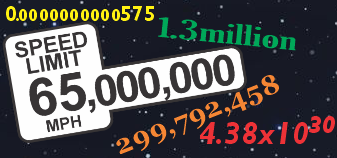
 Science uses lots of numbers describing things like distance and mass. The sun is big enough to hold 1.3 million earth-sized planets; light travels 650,000,000 miles per hour; a wave of yellow light entering your eye is .575x10-9 meters long. Our preferred system of measurement is the metric system of meters and grams: a meter is 39.37 inches, and 28.35 grams make one ounce. (It's a better, more earth-based system, so just as well learn to use it and love it!) |
When numbers get very big (or small, we use scientific notation, based on powers of ten. Here's one now:  The cyan 4.38 is called the coefficient. The orange x means 'times'. The yellow 10 is the base, and the green 30 is the exponent . . . so the mass of the Sun can be read, Four point three eight times ten to the 30th. The number 1.3 million can be written  and can also be written 1,300,000 – the exponent shifts the decimal point six places to the left.
( Saves a few zeroes. But consider: the mass of the Sun = 438,000,000,000,000,000,000,000,000,000,000 pounds )
|
|
| |
 |
 |
| no nonsense privacy policy sitemap | |

| Nimda content administration system written by Michael Potts file updated 17 August 2026 copyright © 2003-2026 Caspar Institute |
| this site generated with 100% recycled electrons | |
