
Our closest star – we call it ‘The Sun’ – is the fission powered engine that provides the energy that powers Nature. 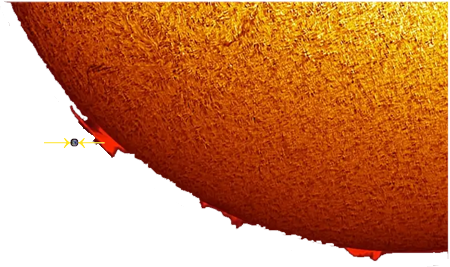 Earth is the tiny blue spot
between the yellow arrows The average distance from Earth to the Sun is about 93 million miles ( 150 million kilometers). This distance is a convenient 'yardstick' for astronomers measuring the universe: the distance from the Sun to our Earth is designated one astronomical unit (AU).
After the Sun, our next closest star, Proxima Centauri is about 268,770 astronomical units (AU) or 4.25 light-years away from Earth. A planet orbiting Proxima Centauri, called Proxima Centauri b, is thought to be the closest habitable exoplanet because it appears to have liquid water on its surface.
Light, traveling 650,000,000 miles per hour, takes 8 minutes and 20 seconds to travel from the Sun to Earth. |  Compared to other stars, our Sun is an average sized yellow dwarf star. Compared to the planet we live on, the Sun is ENORMOUS: big enough to hold 1.3 million ( 1.3x10⁶ ) Earths. With a diameter of 864,000 miles (1,392,000 or 1.392x10⁶ kilometers), the Sun is 109 times wider than Earth. Another way of thinking about that: it's about 25,000 miles around the Earth's equator. If you could travel around the sun (a distance of 2.7x10⁶ miles) as fast as once around the Earth in one day, it would take you 109 days (and your tail feathers would get very hot!) The Sun's surface temperature is about 10,000 degrees Fahrenheit (5,500° Celsius or 5,800 Kelvin). The Sun's outer layer, called the photosphere, is incandescent, its excited atoms spew photons (light particles) at an unbelievable rate. |
By the time light reaches Earth, it lands with about 1.3 kilowatts of energy per square meter, or 173,000 terawatts shining on Earth at any given moment – that's about 10,000 times as much as all the energy produced by human means (all vehicle engines, power generators, industrial processes, and barbecue grills combined.) Of course, harvesting that energy is the trick. You can do it with your face (but keep your eyes closed!) by standing in the bright sun and feeling sunlight convert itself to warmth on your skin. Until 1956, doing, and building houses with windows facing south (or north in the Southern Hemisphere) was about the only way humans could do it. (Of course, plants do it all the time.)  Increasingly since the late 1950s, photovoltaic panels have been coverting insolation – sunlight arriving from the Sun – into electricity at an efficiency of up to 20%, or about 260 watts per square meter, or enough energy to light ten common LED light bulbs. | Now wait a minute:
|
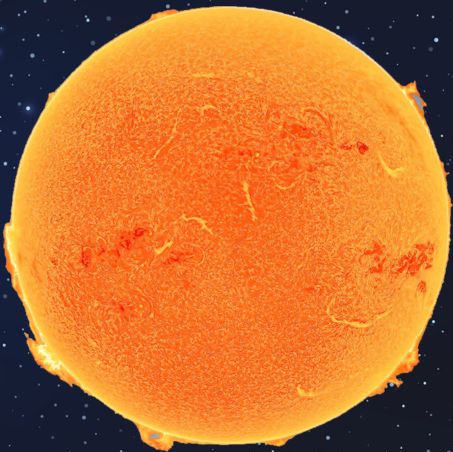 Perpetually fascinating, and an object of worship for millennia, our Sun is spectacular . . . but don't look straight at it! For suggestions about looking at the Sun, check out these pages | 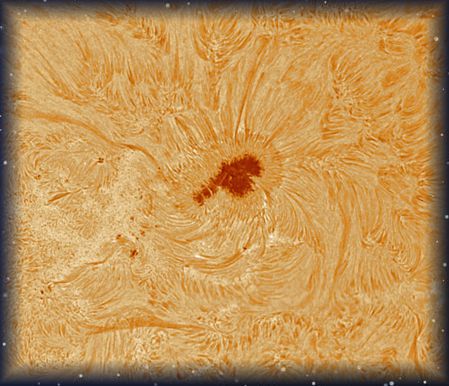 The surface of the Sun, often bespeckled with sunspots, reveals the chaotic churning that generates all the light it emits. |
|
Structure of the Sun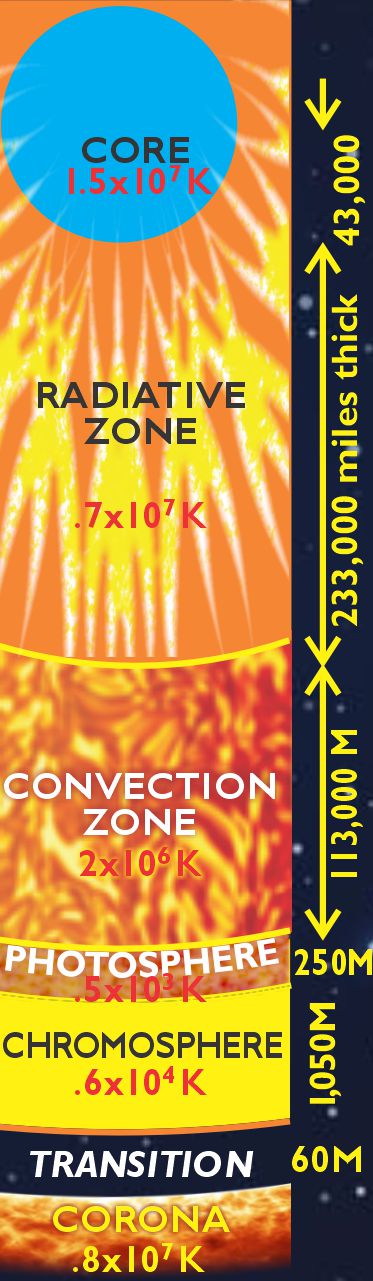 The core is where nuclear reactions consume hydrogen to form helium. These reactions release the energy that ultimately leaves the surface as visible light. The core is where nuclear reactions consume hydrogen to form helium. These reactions release the energy that ultimately leaves the surface as visible light.In the radiative zone, energy moves outward from the core by radiation Energy continues outward through the convective zone by convection The photosphere is the visible surface of the Sun. The chromosphere is an irregular layer where the temperature rises from 6000°C to about 20,000°C. Transition is a thin and very irregular layer of the Sun’s atmosphere that separates the hot corona from the much cooler chromosphere. The corona, the Sun's HOT outer atmosphere (.8x107° Kelvin), extends far out into space. [ who's Kelvin? ] | How did astrophysicists figure out the structure of the sun?
Because the Sun is a giant, opaque ball of hot plasma 93 million miles away, astrophysicists could not simply look inside to see its internal structure. Instead, they figured out the Sun’s layers by combining theoretical physics models, helioseismology (listening to sunquakes), and neutrino detection (capturing ghostly subatomic particles). These techniques reveal that the Sun is structured into distinct layers: a nuclear core, a radiative zone, a convection zone, and an atmosphere. Before the technology that can peer beneath the Sun's surface, physicists used basic laws of science – the law of hydrostatic equilibrium – and geological evidence gathered on Earth, scientists theorize that the Sun had been stable for billions of years. This means the immense inward crush of its gravity must be balanced by the outward push of thermal pressure, or it would collapse into a black hole. Astrophysicists formulated computer models using the laws of thermodynamics, fluid dynamics, and nuclear physics and plugged in known values like the Sun's total mass, radius, and total light output (luminosity) to calculate the temperature, density, and pressure needed at every depth to keep the star stable. In the 1960s, better telescopes showed astronomewrs that the surface of the Sun vibrates in a complex pattern of waves. This field, helioseismology, allows mapping of the Sun's layers the same way earthquakes enable seismologists to map Earth's mantle or ultrasound allows doctors to image structures inside a human body. The Sun's turbulent outer layer continuously generates millions of acoustic (sound) waves that travel deep into the Sun, refract (bend) due to changing temperatures and densities, and bounce back (reflect) up to the surface where they can be detected. By measuring how these waves shift the light on the surface, scientists worked backward to map the interior. Helioseismology directly confirmed the boundaries of the Sun’s internal layers, including the depth where the radiative zone transitions into the roiling convection zone. While helioseismology mapped the physical layers, scientists still needed proof that nuclear fusion was actually happening in the core. Photons (light particles) created in the core may take longer than 100,000 years to slowly bounce their way to the solar surface, fusion also creates neutrinos – nearly massless, ghostly particles created during nuclear fusion that are so small that the seldom interact with matter. Neutrinos fly straight out of the Sun's core completely unimpeded, reaching Earth in just over eight minutes. Starting in the late 1960s scientists were able to detect these elusive particles. Measuring the flow of neutrinos allowed scientists to confirm the temperature and fusion rates operating inside the Sun's core. To figure out what the Sun is actually made of, astrophysicists used spectroscopy – splitting sunlight into a rainbow spectrum – they observed dark gaps called absorption lines. Every chemical element leaves a unique 'fingerprint' line. In 1925, British astrophysicist Cecilia Payne-Gaposchkin |
|
| |
 |
 |
| no nonsense privacy policy sitemap | |

| Nimda content administration system written by Michael Potts file updated 5 September 2026 copyright © 2003-2026 Caspar Institute |
| this site generated with 100% recycled electrons | |

 1618 Johannes Kepler, a German astronomer, formulated his Third Law, that defined the mathematical relationship between how long planets take to orbit the Sun and their relative distance from it.
 used this data to prove that the Sun is almost entirely made of hydrogen and helium, matching the precise chemical fuel required by the standard solar models to support fusion.