
Wait a minute! What has water to do with light and the Sun? For those of us living on planet earth, plenty. As far as scientists can tell, liquid water is the most critical requirement for life: water enables life. Careful student researcher Tim Blonde writes, in answer to the question Are there any organisms that exist without water? Tardigrades are polyextremophiles and are able to survive in extreme environments that would kill almost any other animal. Some can survive temperatures of -273°C, close to absolute zero, temperatures as high as 151 °C (303 °F), 1,000 times more radiation than other animals such as humans, almost a century without water, and even the vacuum of space. In September 2007, tardigrades were taken into low Earth orbit on the FOTON-M3 mission and for 10 days were exposed to the vacuum of space. After they were returned to Earth, it was discovered that many of them survived and laid eggs that hatched normally, making these the only animals shown to be able to survive the vacuum of space.
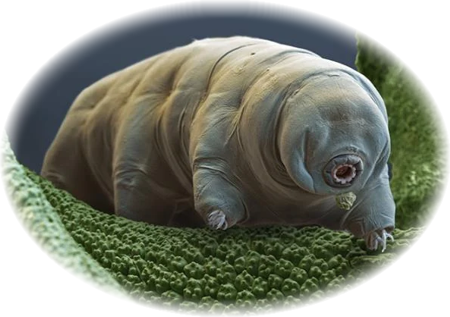 Tardigrades (water bears) are microscopic, ranging from 0.3 mm to 1.2 mm (0.01 to 0.05 inches). |
This question becomes really important when we consider two other questions: Q: What is necessary to sustain human life (or any life) in space, or on the Moon or on another planet? A: First off, a lot of water. Then air, food, warmth, the usual stuff. But water is first. Scientists have perfected salvaging water from urine (do NOT say ‘Eeew!’) But to survive long term, a good supply of water may turn out to be the weightiest part of the cargo. Q: Have astronomers found any planets orbiting other stars that could support life? A: Planets orbiting other stars are called exoplanets, and the principal requirement astrophysicists apply when identifying a habitable exoplanet is detectable presence of liquid water – water in an temperature environment between 0°C (32° F) and 100°C (212° F), freezing and boiling. They call this the Goldilocks Zone. |
|
| |
 |
 |
| no nonsense privacy policy sitemap | |

| Nimda content administration system written by Michael Potts file updated 31 August 2026 copyright © 2003-2026 Caspar Institute |
| this site generated with 100% recycled electrons | |
